
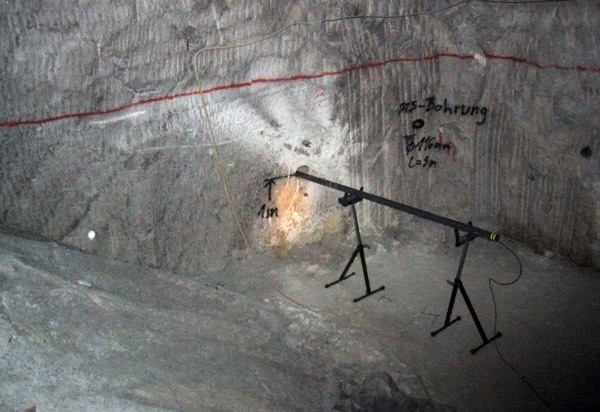
The underground mining operation for raw materials is planned and monitored by geological measurements. One method is drill-core analysis, whereas borehole radar systems are primary tools to map the surrounding area of the borehole.
Project Details
Nowadays mostly borehole radar systems with omni-directional receiving antennas are utilized. These systems can only measure the reflector distance, whereas directional antennas can estimate the azimuthal angle additionally. The antenna dimensions are limited by the borehole diameter. Therefore the signal wave length is much greater than the radial antenna dimension resulting in small received signal levels.
The low antenna sensitivity is best recorded with an adaptive receiver electronics. The electronics has to be located at the antenna-feed-point for best results. The needed communication link must not disturb the antenna properties by poorly arranged electrical conductive materials.
Receiver Design for a Directional Borehole Radar System
This work contains the system design of an adequate directional receiver system with focus of the adaptive electronics at the antenna feed-point. The receiver is designed for a minimum of noise which results in parameter inaccuracies. In this connection a calibration method was developed to synchronize the receiver channels and correct the measurement data. The implemented receiver was analyzed with measurement data recorded in underground mines.